
Double Deep Pallet Racking
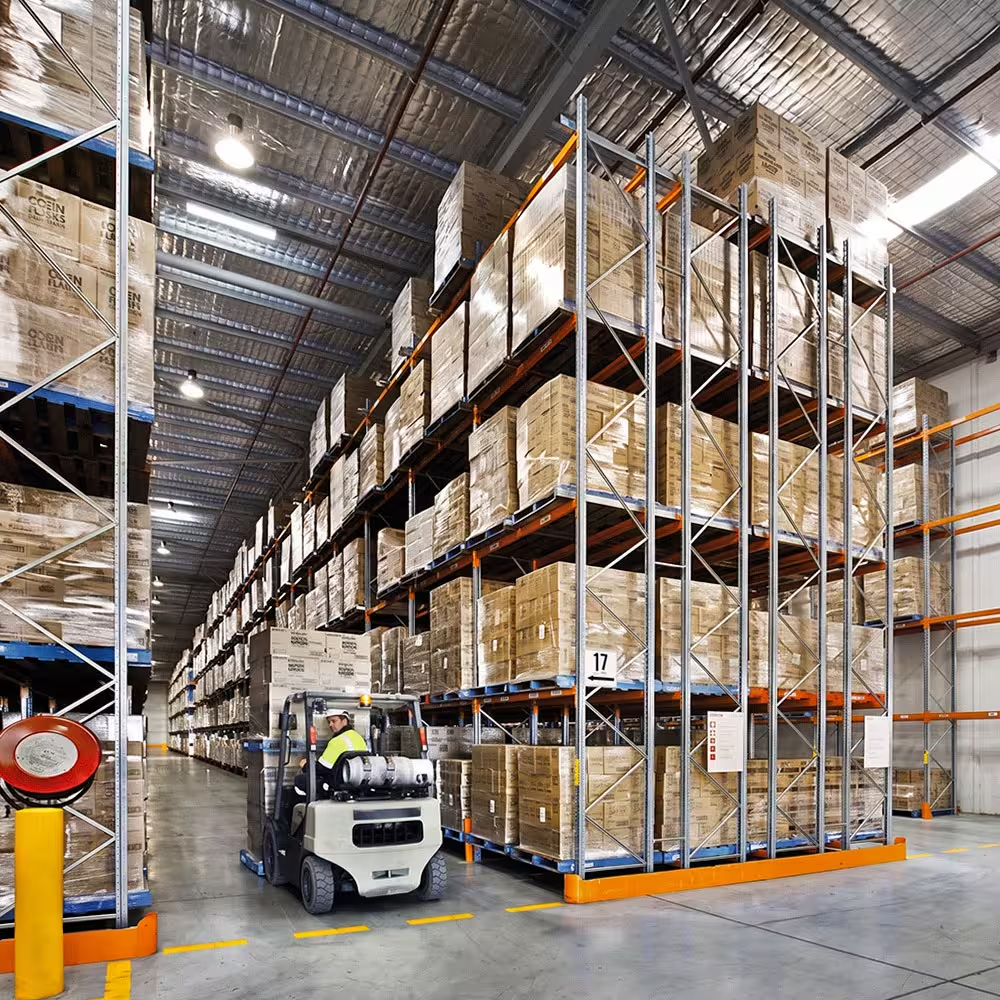
Double Deep Pallet Racking increases pallet capacity by storing pallets two-deep in double-entry configurations, reducing access aisles and boosting floor space utilization. Constructed using heavy-duty selective racking components and AS4084 compliant, it delivers 50% immediate pallet selectivity with over 90% floor occupancy efficiency when paired with standard pantograph reach trucks or deep-reach forklifts.
- Categories: Pallet Racking
- Availability: Express Dispatch
- Product Type: Simple
High-Density Storage with Fast Throughput Efficiency
Double Deep Pallet Racking bridges the gap between single-selective racking and ultra-dense drive-in systems. By storing pallets two deep in back-to-back rows (creating four-pallet-deep double-entry blocks), this system eliminates redundant forklift aisles – increasing total pallet capacity by up to 50% without requiring structural building modifications.
Built with heavy-duty components identical to standard selective pallet racking, Double Deep setups maintain 50% immediate pallet selectivity while achieving typical warehouse storage location utilization rates exceeding 90%. It is the preferred storage solution for manufacturing facilities, logistics warehouses, and distribution centres handling medium-throughput stock, multiple pallets per SKU, and predictable batch inventory rotations.
Key Features & Benefits
- 50% Greater Storage Density: Stores pallets two-deep from each aisle side, eliminating every second forklift access aisle and maximising floor capacity.
- Over 90% Location Occupancy: Maximises total available cube space compared to single selective systems.
- Cost-Effective System Architecture: Utilises standard, proven selective racking upright frames, beams, and footplates, keeping capital installation costs low.
- 50% Instant Selectivity: Offers balanced stock accessibility and structured rotation for facilities holding 2–4 pallets of identical SKUs.
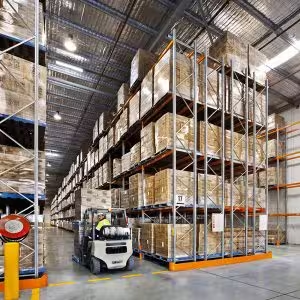
- Standard Reach Truck Operation: Operates efficiently using standard reach trucks fitted with hydraulic pantograph double-reach scissor mechanisms or telescopic deep-reach forks.
- Modular & Scalable: Easily reconfigured, extended, or converted back to single selective racking if operational workflows change.
Reach Handling & Operational Requirements
Because forklifts must extend into the second pallet depth, double deep racking works in tandem with specialised material handling equipment:
- Double-Reach Pantograph Forklifts: Reach trucks fitted with extended scissor mechanisms that push and pull pallets from the rear position.
- Telescopic Fork Attachments: Hydraulic sliding forks designed for deeper bay penetration.
- Pallet Support Bars & Guide Systems: Lower rear beams are often fitted with structural pallet support channels or guide rails to help operators accurately position rear pallets at height.
AS4084 Compliance & Structural Engineering
Because loads are handled at double the outreach, frame loading calculations, beam safety locks, and floor anchor tolerances are critical. Direct Storage Systems supplies and installs double deep systems in full compliance with Australian Standard AS 4084 (Steel Storage Racking) and WorkSafe guidelines.
Every system includes certified Safe Working Load (SWL) signage, safety locking pins on all beam connections, and reinforced column baseplates.
On-Site Measuring, CAD Layouts & Local Supply
Planning a double deep layout requires precise coordination between your pallet overhang, ceiling clearance, and forklift pantograph reach capacities. Direct Storage Systems offers on-site site surveys and detailed 2D/3D CAD layout planning across Geelong, the Surf Coast, and Western Melbourne.
Product Documentation
Double deep pallet racking stores pallets two-deep in back-to-back configurations, allowing four pallet rows between each forklift access aisle. By eliminating every second aisle required in a standard selective racking layout, double deep racking increases storage capacity by up to 50% while maintaining rapid stock access.
Double deep racking requires specialised material handling equipment fitted with deep-reach capabilities. This is typically operated using a pantograph reach truck or a forklift equipped with telescopic fork attachments (scissor reach extensions) designed to reach the rear pallet position.
Double deep pallet racking operates primarily on a First-In, Last-Out (FILO) inventory management principle for each individual two-pallet slot. It is best suited for warehouses storing medium-to-large quantities of identical SKUs where direct access to every single pallet is not essential.
Double deep rows generally pair standard Australian frame depths (such as 838mm or 1219mm) connected by heavy-duty row spacers to maintain proper flue spaces. Standard beam lengths range from 2591mm (2-pallet entry) to 3810mm (3-pallet entry), engineered to carry the specific point loads of both front and rear positions.
Yes. Pallet guide bars, lower guide tracks, and upper-level pallet supports are strongly recommended. Because operators have reduced visibility when placing pallets into the deep second position at height, guide rails help line up the pallet accurately and prevent placement errors.
Yes. All double deep racking components supplied and installed by Direct Storage Systems comply strictly with AS 4084 (Steel Storage Racking). Every installation is supplied with certified safe working load signage outlining maximum beam ratings and permissible upright loads.
While drive-in racking delivers higher density, double deep racking offers greater selectivity and flexibility. Double deep provides 50% direct pallet selectivity compared to drive-in's bulk-lane structure, allowing faster retrieval times and easier SKU segregation without requiring the forklift to drive inside the racking structure.
Yes. Direct Storage Systems provides complete CAD layout design, certified engineering, supply, and professional installation for new and quality-inspected used double deep racking systems across Melbourne, Geelong, and regional Victoria.
Share options