
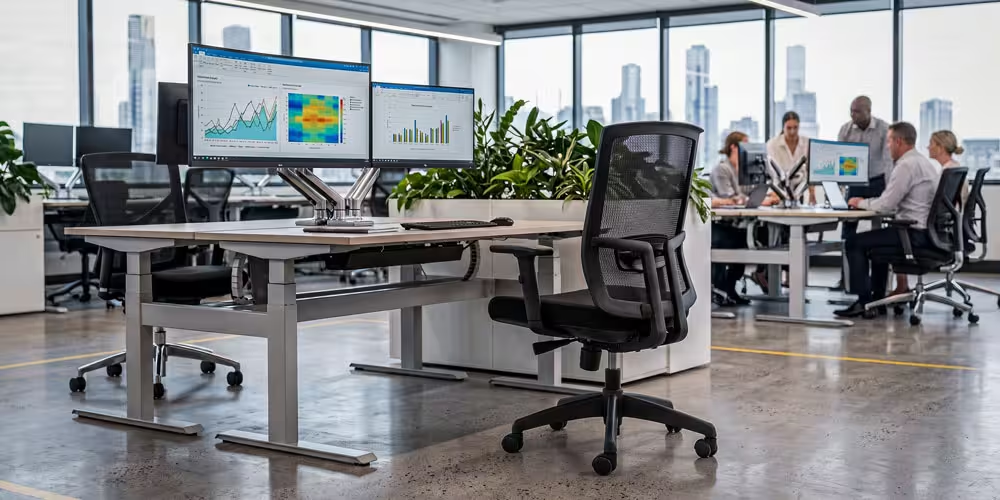
How to Choose the Right Commercial Office Chair: Ergonomics, Daily Use, and Australian Standards
A quality workstation is only as effective as the chair paired with it. With full-time office professionals spending between 35 and 45 hours seated every week, selecting appropriate commercial seating directly impacts posture, employee comfort, workplace productivity, and long-term musculoskeletal health.
1. Match the Chair Mechanism to Daily Usage Hours
Office chairs are engineered around specific duty cycles. Choosing a chair with insufficient adjustability for an eight-hour workday can lead to static muscle fatigue and poor lumbar alignment.
| Mechanism Type | Recommended Duty | Key Adjustments | Best Suited For |
|---|---|---|---|
| Single Lever / Task | 1 to 3 hours per day | Gas-lift height adjustment; fixed or manual back angle | Meeting rooms, boardrooms, casual hot-desks, and visitor spaces |
| 3-Lever Independent | 4 to 8 hours per day | Independent seat height, seat tilt, and backrest angle levers | Standard administrative desks, data entry, and intensive individual workstations |
| Synchro / Dynamic Tilt | 8+ hours per day | Synchronised 2:1 back-to-seat tilt with tension control and multiple lock positions | Executive desks, high-performance task seating, and 24/7 control room environments |
2. Australian Standards and AFRDI Certification Explained
Commercial furniture must withstand far greater mechanical fatigue than domestic seating. When sourcing commercial seating in Australia, verify compliance with recognised performance benchmarks:
AS/NZS 4438:1997 (Height Adjustable Swivel Chairs)
The principal Australian and New Zealand standard for commercial task seating is AS/NZS 4438:1997. This standard defines rigorous dimensional criteria, structural strength requirements, stability limits, and component durability tests.
What Does AFRDI Level 6 Mean?
The AFRDI Certification scheme tests commercial furniture against severe commercial use standards. Seating certified to AFRDI Level 6 is rated for extremely demanding commercial applications, including multi-shift operations, government fitouts, educational institutions, and heavy daily use.
Buying Tip: Look for products backed by a blue AFRDI Level 6 certificate. This verification guarantees the five-star base, gas-lift cylinder, seat foam resilience, and tilt mechanism have passed tens of thousands of continuous loading cycles without failure.
3. Essential Ergonomic Adjustments to Check
To support proper spinal alignment and healthy blood circulation throughout the working day, a commercial task chair should offer these key adjustment points:
- Pneumatic Height Adjustment: The gas lift must allow the user to sit with feet flat on the floor or on an ergonomic footrest, with knees bent at a 90 to 100 degree angle and thighs parallel to the floor.
- Adjustable Lumbar Support: The lumbar curve of the backrest must adjust vertically or in depth to support the natural inward lordotic curve of the lower spine, preventing slouching.
- Seat Pan Depth (Seat Slider): A sliding seat mechanism ensures users of different heights can maintain back contact with the lumbar rest while leaving a gap of two to three fingers (approximately 30mm to 50mm) between the front edge of the seat and the back of their knees.
- Waterfall Front Edge: A gently rounded front edge on the seat cushion reduces pressure on the popliteal area behind the knees, promoting healthy circulation to the lower legs.
- Adjustable 2D, 3D, or 4D Armrests: Optional armrests should adjust in height, depth, and angle to support forearms without pushing the shoulders upward or preventing the chair from tucking under the desk.
4. Material Selection: Breathable Mesh vs. Moulded Foam
Both high-tensile mesh and high-density moulded foam provide distinct performance qualities for commercial applications:
| Feature | Breathable Mesh Back | Commercial Moulded Foam |
|---|---|---|
| Thermal Regulation | Exceptional airflow; keeps users cool in warm office environments | Retains warmth; provides a supportive, cushioned feel |
| Pressure Distribution | High-tensile mesh flexes dynamically with movement | Anatomically contoured foam distributes body weight evenly |
| Durability Profile | Quality elastomer mesh maintains tension without sagging | High-resilience foam resists flattening and retains shape for years |
| Cleaning & Care | Quick to vacuum and wipe clean | Available in commercial-grade wool, polyester, or heavy-duty vinyl |
5. Safe Working Loads and Commercial Warranties
Standard domestic office chairs often carry limited load ratings of 100kg to 110kg and short 12-month warranties. Commercial task chairs intended for corporate and industrial fitouts should feature:
- Load Ratings: Certified for a minimum Safe Working Load of 130kg to 160kg UDL for standard models, or up to 200kg+ for heavy-duty bariatric seating.
- Commercial Warranties: Look for a manufacturer warranty of 5 to 10 years on the frame, mechanism, and structural components to ensure reliable return on investment.