
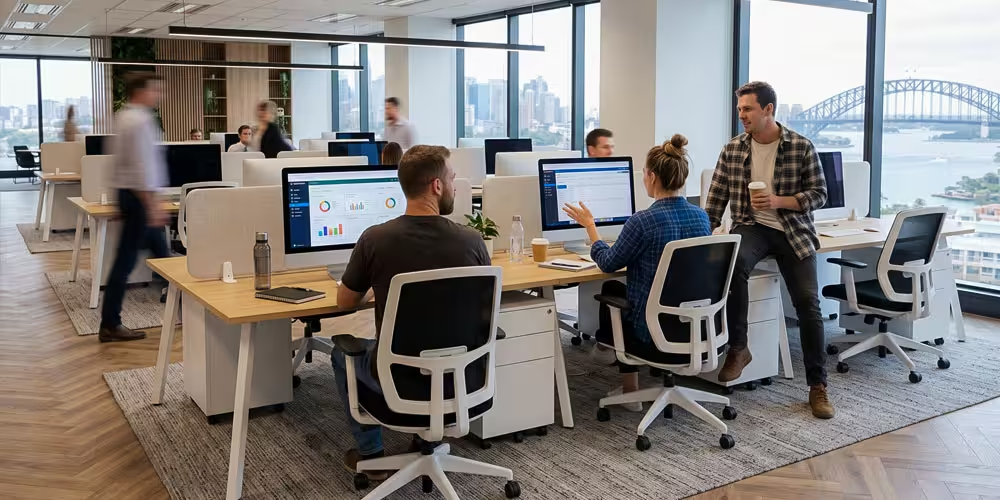
The Ergonomic Payoff: Why an Inviting Office Workspace Directly Drives Productivity and Retention
Across Australia, the conversation around the workplace has shifted permanently.
As hybrid arrangements mature, business owners, managing directors, and operations leads face a straightforward operational challenge: making the physical office an environment where people can actually get high-value work done.
When employees make the morning commute, they expect an environment that supports their output – not one that drains their energy before lunch. Yet in many commercial settings, staff leave carefully tailored home work areas only to arrive at cluttered desks, noisy open-plan floorplates, and mismatched seating that causes physical strain.
Investing in a comfortable, functional, and well-organised workspace is not an exercise in interior decoration. It is an operational lever that reduces absenteeism, lowers error rates, and protects your bottom line.
What the Australian Data Tells Us: Health, Focus, and Retention
The connection between physical comfort and business performance is well documented across Australian workforce health and ergonomics research.
1. The Cost of Physical Discomfort (Safe Work Australia)
Sedentary office work presents serious physical risks when workstations are poorly configured. According to Safe Work Australia, musculoskeletal disorders (MSDs) – including lower back pain, repetitive strain injuries, and chronic neck or shoulder stiffness – account for approximately 50% of all serious workers’ compensation claims nationwide.
Even without a formal claim, low-grade physical pain causes continuous “presenteeism,” where employees are at their desks but working well below capacity due to constant physical distraction.
2. Measurable Gains in Task Focus (University of Sydney)
Research from the Indoor Environmental Quality (IEQ) Lab at the University of Sydney demonstrates that environmental factors – including ergonomic posture support, acoustic buffers, and clean visual sightlines – deliver a 10% to 15% uplift in individual task performance.
When people aren’t fighting glare, cramped legroom, or physical back fatigue, cognitive endurance extends comfortably into the afternoon.
3. The Commute Justification (AHRI Workforce Sentiment)
Studies by the Australian HR Institute (AHRI) indicate that more than 60% of Australian knowledge workers view physical desk comfort, noise management, and quality workstations as primary drivers of whether they view office days as productive or frustrating. Perks like free morning tea matter far less than having a quiet, supportive space to work.
Conquering “Visual Noise”: The Operational Cost of Clutter
A messy desk is not just an eyesore; it imposes a continuous tax on mental bandwidth. When paperwork, product samples, charging cords, and project folders spill across worktops, the brain is forced to filter out that background chaos continuously.
By establishing a clear separation between active task surfaces and organised storage, you immediately reduce workplace friction:<M/p>
- Under-Desk Mobile Pedestals (Caddies): Providing each desk with a locking 2-drawer or 3-drawer mobile pedestal ensures personal belongings, technical cables, and active notebooks stay off the desktop.
- Commercial Steel Tambour Units: Sliding tambour doors retract completely into the cabinet shell, allowing high-density filing and binder storage in narrow office corridors without door swings blocking pedestrian walkways.
- Stationery & Office Cupboards: Consolidating company-wide stationery, printer supplies, and equipment in clean, locking steel cabinets keeps communal surfaces tidy.
Modern Workstation Ergonomics: Designing for Natural Posture
Sitting frozen in a single posture for eight hours a day runs counter to human physiology. A productive commercial workstation must support natural movement while keeping key tools within easy reach.
| Ergonomic Element | Common Fit-Out Mistake | The Commercial Standard |
|---|---|---|
| Desk Surface Stability | Lightweight flat-pack tables that shake or bounce under typing and dual-monitor mounts. | Heavy-gauge commercial steel sub-frames with durable laminate tops and integrated cable channels. |
| Under-Desk Clearance | Cross-bracing or junk piled in the knee well, forcing employees to twist or sit at an angle. | Completely unobstructed legroom allowing full leg extension and swivel mobility. |
| Task Seating | Fixed-back conference chairs or worn-out foam padding lacking lumbar support. | Commercial-grade mesh task chairs featuring multi-lever tilt adjustment, adjustable lumbar support, and breathable fabric. |
| Sightline Alignment | Laptops placed flat on desks, forcing workers into a continuous downward neck crane. | Adjustable monitor arms that position the top third of the screen directly at eye level. |
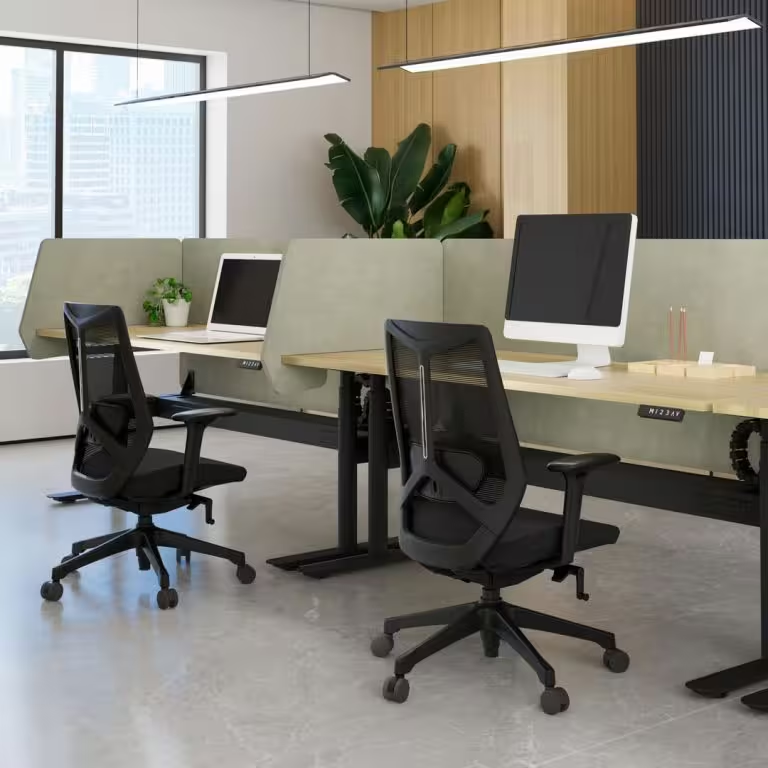
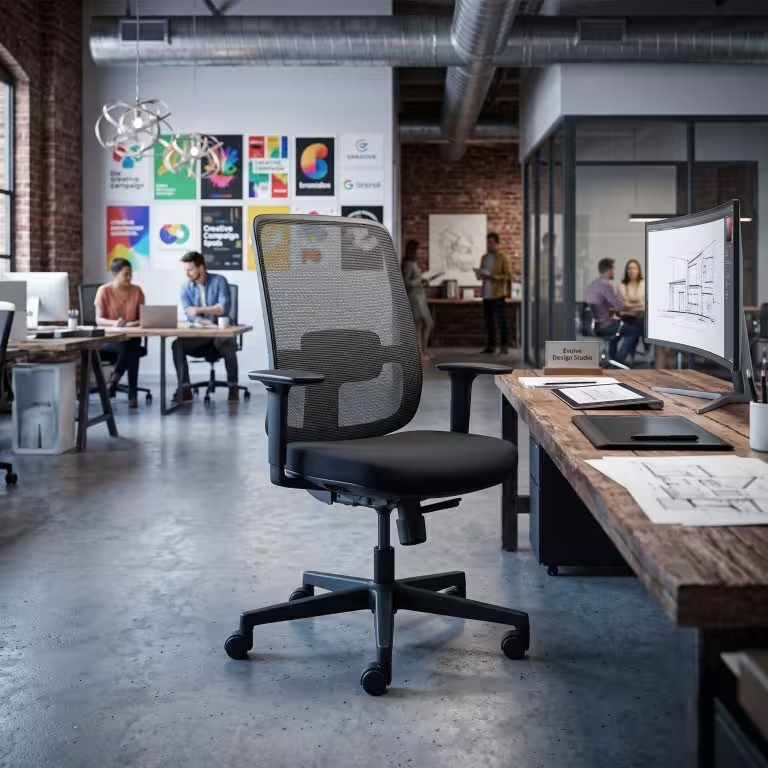
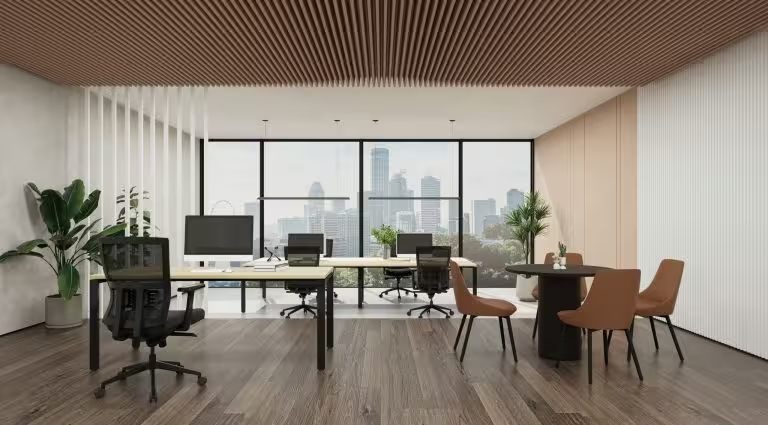
Office Zoning: Balancing Team Collaboration with Deep Work
The primary flaw of early 2000s open-plan layouts was the assumption that all work is collaborative. In reality, a productive commercial office requires clear spatial zoning:- Collaboration Hubs: Open tables, whiteboards, and casual meeting areas placed near entrances or kitchenettes where natural conversation won’t disrupt others.
- Dedicated Focus Zones: Desks positioned away from main circulation pathways, loud printers, and entry doors, allowing team members to dive into complex documentation, engineering plans, or financial tasks without interruption.
- Buffer Zones: Using storage banks, acoustic screens, or filing credenzas as physical and sound-absorbing room dividers to delineate departments without having to build structural plasterboard walls.
A 4-Step Checklist for Office and Operations Managers
To evaluate your current office setup, walk your floor and run this 60-second operational audit:- The Foot-Well Test: Look beneath your team’s desks. Are power boards, network cables, or archived boxes restricting legroom?
- The 30-Second Rule: Can an employee find a client archive, project file, or spare toner in under 30 seconds, or does it require searching through loose piles?
- The Posture Check: Are team members leaning forward with rounded shoulders, or are their chairs adjusted to support their lower back with elbows at a clean 90-degree angle?
- The Acoustic Buffer: Is your accounts or planning team sitting right next to the dispatch door or the main telephone bank?
Build an Office That Works as Hard as Your Team
A productive, comfortable office environment pays dividends every single day. By investing in heavy-duty commercial workstations, proper ergonomic seating, and streamlined steel storage, you protect your staff’s physical wellbeing while providing a workspace that genuinely drives results.Looking to upgrade your commercial office space or streamline your layout?
Direct Storage Systems supplies a comprehensive range of commercial office furniture, steel filing cabinets, and ergonomic task seating directly from our North Geelong warehouse. Contact our team today on (03) 5277 0826 or visit our showroom to plan a layout that works for your business.
Share options